INDUSTRIAL GUIDE
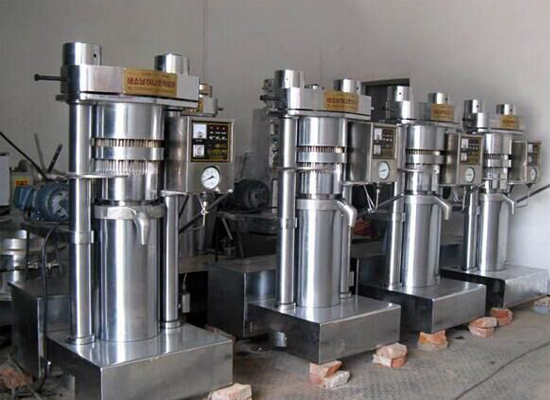
Key Insight: The pretreatment module serves as the critical foundation of your oil extraction system, directly impacting oil yield by 15-25% and overall plant efficiency by up to 30%. This guide walks you through proven design methodologies to ensure your facility meets production targets while minimizing operational bottlenecks.
Before oilseeds reach the press or solvent extraction stage, their preparation directly influences your bottom line. A well-designed pretreatment module ensures uniform particle size, optimal moisture content, and proper conditioning—factors that collectively determine oil yield, energy consumption, and equipment longevity.
Consider this: A 5% increase in oil yield for a facility processing 500 tons/day of soybeans translates to approximately 25 additional tons of oil monthly, representing significant revenue potential. This is why industry leaders prioritize pretreatment optimization as a core investment.
One of the most common pitfalls for new oil processing facilities is inadequate storage capacity, leading to production interruptions and quality issues. The storage design must account for raw material arrival schedules, seasonal supply fluctuations, and processing continuity.
The basic principle for determining minimum storage capacity is straightforward:
Minimum Storage Capacity (tons) = Daily Processing Volume × Safety Factor × Storage Days
Where:
Different oilseeds have unique storage characteristics that impact your design:
| Oilseed Type | Recommended Storage Days | Special Considerations |
|---|---|---|
| Soybeans | 5-7 days | Low moisture sensitivity (12-14% ideal) |
| Palm Kernel | 3-5 days | High oil content requires cooler storage |
| Rapeseed | 7-10 days | Prone to self-heating; aeration recommended |
| Sunflower Seeds | 5-8 days | Delicate hull requires careful handling |
.jpg)
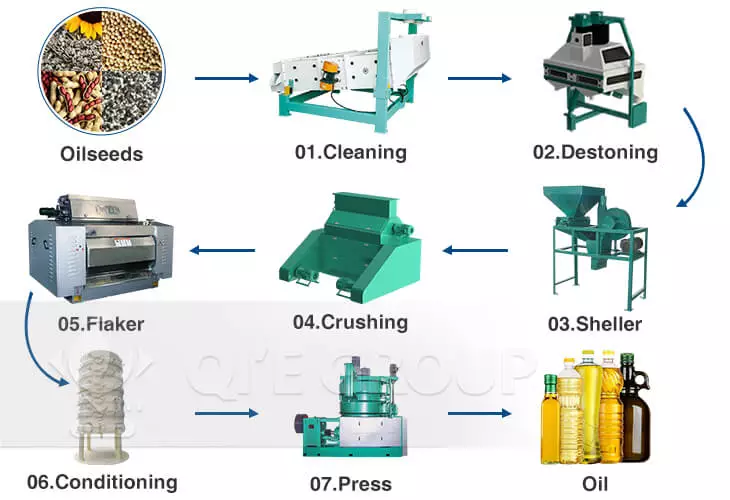
The粉碎 stage represents a critical decision point that affects downstream processing efficiency. The choice between hammer mills and roller mills depends on your oilseed type, desired particle size, and energy considerations.
| Parameter | Hammer Mills | Roller Mills |
|---|---|---|
| Particle Uniformity | Lower (wide size distribution) | Higher (consistent particle size) |
| Energy Consumption | Higher (15-20% more kWh/ton) | Lower (more efficient crushing) |
| Ideal Applications | Soft seeds, multi-purpose plants | Oilseeds with high oil content, large-scale operations |
| Maintenance Requirements | Higher (frequent hammer replacement) | Lower (roller resurfacing every 6-12 months) |
| Capital Cost | Lower initial investment | Higher initial investment, better long-term ROI |
Proper conditioning transforms raw oilseeds into a uniform material ready for efficient oil extraction. The two critical parameters in this stage are steam pressure and retention time.
Steam pressure directly affects heat transfer and moisture addition to the seed mass:
The duration seeds spend in the conditioner allows for proper moisture and heat penetration:
Optimal Retention Times: 8-15 minutes depending on seed type, with harder seeds requiring the upper end of this range. Insufficient time leads to uneven conditioning, while excessive time can cause oil oxidation and quality degradation.
.jpg)
In a recent project in West Africa, a palm kernel processing facility was struggling to reach its designed capacity of 100 tons/day, consistently operating at only 70-75 tons despite having adequate press capacity.
Our analysis revealed several pretreatment bottlenecks:
By implementing a comprehensive pretreatment redesign including proper storage capacity calculation, switching to roller mills, and optimizing the conditioning parameters, the facility consistently achieves 105-110 tons/day—representing a 30% increase in effective capacity without any changes to their press equipment. This resulted in an additional 1,500 tons of processed material monthly and significantly improved oil yield.
Every oil processing facility has unique requirements based on raw material characteristics, production goals, and local conditions. Rather than forcing standard solutions, 企鹅集团 (Penguin Group) takes a collaborative approach to develop pretreatment modules that align perfectly with your specific needs and long-term objectives.
Our team of process engineers will conduct a comprehensive assessment of your current operation or planned facility, providing customized recommendations to maximize your oil yield and production capacity.
Get Your Custom Pretreatment Design ProposalRemember that pretreatment is not merely a preliminary step but the foundation of a

 353
|
353
|
 Large hydraulic press maintenance
Hydraulic system maintenance skills
Vegetable oil press equipment fault prevention
Pre - press daily inspection
Industrial equipment preventive maintenance
Large hydraulic press maintenance
Hydraulic system maintenance skills
Vegetable oil press equipment fault prevention
Pre - press daily inspection
Industrial equipment preventive maintenance
 372
|
soybean crushing particle size
oil press equipment efficiency
crushing particle size control
oil extraction process optimization
industrial oilseed pretreatment
66
|
Large - scale hydraulic pre - press machine
Vegetable oil pre - pressing process
Equipment maintenance points
Pre - press machine selection
Vegetable oil processing technology
372
|
soybean crushing particle size
oil press equipment efficiency
crushing particle size control
oil extraction process optimization
industrial oilseed pretreatment
66
|
Large - scale hydraulic pre - press machine
Vegetable oil pre - pressing process
Equipment maintenance points
Pre - press machine selection
Vegetable oil processing technology
.jpg?x-oss-process=image/resize,h_300,m_lfit/format,webp) 159
|
industrial oil press equipment
crushing granularity control
pressing efficiency
oilseed processing
pretreatment technology
334
|
hydraulic seed oil extraction
oil yield optimization
seed preprocessing temperature
hydraulic oil press parameters
automated oil extraction systems
159
|
industrial oil press equipment
crushing granularity control
pressing efficiency
oilseed processing
pretreatment technology
334
|
hydraulic seed oil extraction
oil yield optimization
seed preprocessing temperature
hydraulic oil press parameters
automated oil extraction systems






.jpg)