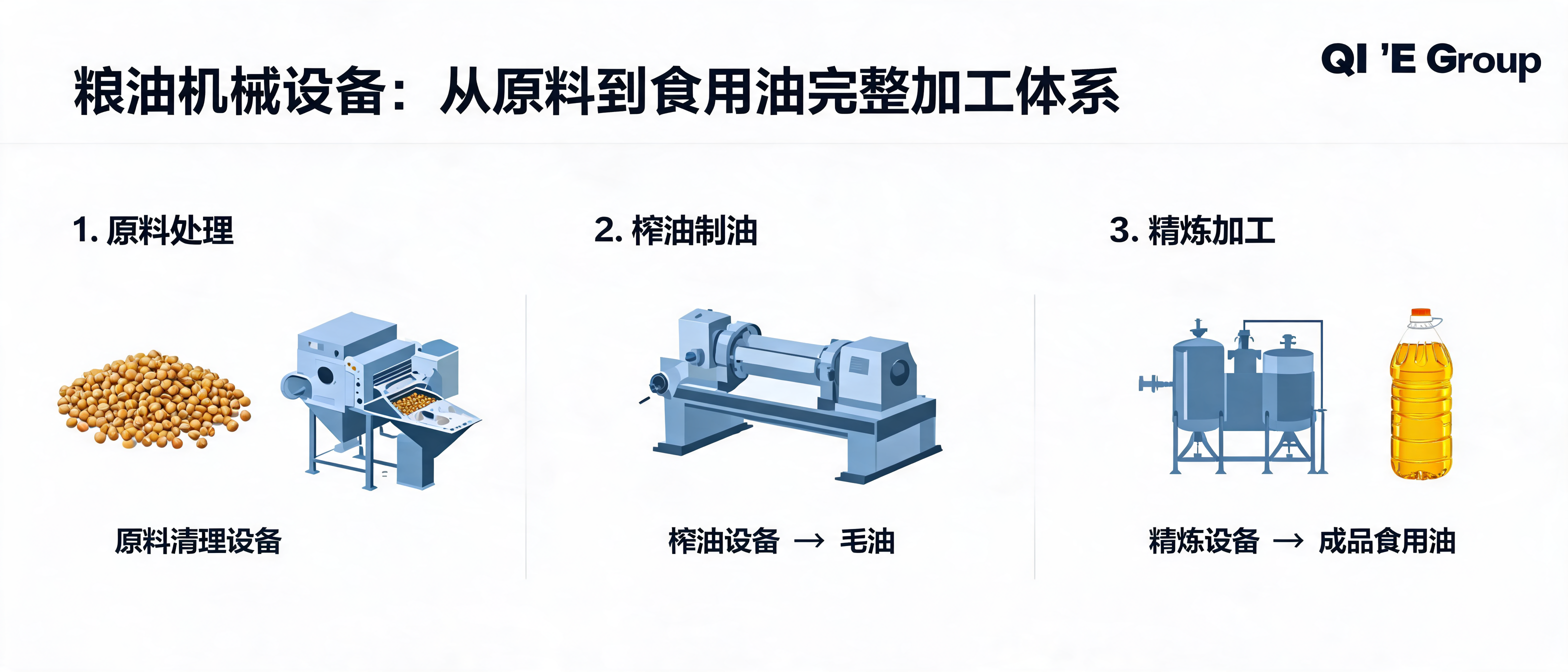
Selecting edible oil production line equipment is a process decision rather than a single-machine purchase. The appropriate configuration depends on the oilseed or nut being processed, planned production capacity, desired oil quality, processing route, refining requirements, and the level of automation needed for daily operation.
Qi'e Grain and Oil Machinery Co., Ltd. supports B2B processors with oil pressing equipment, oil extraction process equipment, and edible oil refining equipment. A systematic evaluation helps align each equipment module with the project’s feedstock, product objectives, site conditions, and long-term operating requirements.
Oil-bearing materials do not behave the same during preparation, pressing, extraction, or refining. Before selecting an edible oil production line, define the feedstock characteristics and the intended use of the finished oil. This establishes the basis for choosing suitable equipment and process conditions.
Consider the type of seed or nut, moisture condition, cleanliness, shell or hull content, and the material’s response to heat and pressure. These factors influence preparation and pressing performance.
Clarify whether the goal is crude oil for further refining, oil with a natural sensory profile, an ingredient for food processing, natural cosmetic oil, or industrial-use oil.
Determine whether the plant requires continuous operation, flexible batch production, or a scalable arrangement that can be integrated with an existing production line.
A complete edible oil production line may include material receiving and preparation, oil pressing or extraction, crude oil handling, filtration, refining, and supporting control systems. The required route should be evaluated as an integrated process, not as isolated equipment.
| Process Module | Selection Focus | Role in the Production Line |
|---|---|---|
| Oilseed preparation | Raw-material condition and process readiness | Prepares oil-bearing materials for stable downstream pressing or extraction. |
| Oil pressing | Feedstock versatility, temperature approach, operating continuity | Uses mechanical pressure to recover oil from suitable seeds and nuts. |
| Solvent extraction | Project process design, safety requirements, and plant-wide coordination | Provides an extraction route for projects whose process requirements call for it. |
| Edible oil refining | Required finished-oil specification and refining standard | Supports the treatment of crude oil according to the intended finished product requirements. |
The pressing temperature should be selected according to the raw material, oil characteristics, and product objective. Hot pressing and cold pressing are not interchangeable labels; they are process choices that should be coordinated with material preparation and downstream oil treatment.
Hot pressing uses controlled heat during processing. Equipment selection should account for temperature control, material behavior, operating stability, and the planned crude-oil treatment process.
Cold pressing is selected when processors place emphasis on retaining the natural characteristics of the oil. The process still requires suitable raw-material preparation, stable operation, and realistic capacity planning.
A practical selection principle is to evaluate pressing temperature together with feedstock properties, intended oil use, and the refining or filtration steps that follow—not as a stand-alone equipment feature.
For processors seeking flexibility in mechanical oil production, a multifunction screw hot and cold oil press can be considered as part of the oil pressing section. This equipment is designed for extracting oil from a range of seeds and nuts and supports both hot-pressing and cold-pressing operation according to processing needs.
Crude oil quality and the desired finished-oil standard determine whether, and to what extent, edible oil refining equipment should be included. Refining requirements affect overall equipment selection, utility planning, process layout, and operational coordination.
Identify the intended end use and the quality requirements applicable to the finished edible oil.
Pressing or extraction performance should be reviewed together with crude-oil handling and refining needs.
Consider the controls, maintenance access, and operating procedures needed for reliable line management.
Automation should be selected according to the processor’s capacity target, operating model, personnel arrangements, and need for process consistency. A more complete evaluation also includes how equipment will be installed, connected, commissioned, and maintained within the production environment.
The most suitable edible oil production line equipment is the configuration that connects feedstock preparation, oil pressing or extraction, refining requirements, and operational controls in a coherent process. Qi'e Grain and Oil Machinery Co., Ltd. approaches equipment selection with attention to the processor’s raw materials, production method, capacity expectations, and project-wide service needs. This helps create a practical foundation for selecting oil pressing equipment, extraction solutions, and edible oil refining equipment that fit the intended operation.

 352
|
 Qi'e Grain and Oil Machinery Co., Ltd. turnkey project delivery installation and commissioning technical service grain and oil machinery case study
320
|
Qi'e Grain and Oil Machinery Co., Ltd. oil pressing equipment oil yield process configuration equipment selection
 151
|
Qi'e Grain and Oil Machinery Co., Ltd. edible oil production line equipment oil processing flow multifunctional hot and cold screw oil press edible oil refining equipment
 141
|
Qi'e Grain and Oil Machinery Co., Ltd. grain and oil machinery oil pressing equipment oil production line edible oil refining equipment
 226
|
Qi'e Grain and Oil Machinery grain and oil machinery oil pressing equipment edible oil production line edible oil refining equipment