Enhancing Spiral Oil Press Export Competitiveness through Efficient Preprocessing: Advantages and Case Studies in Oil Extraction Optimization
2025-11-06
Industry Research
This article provides a comprehensive analysis of the critical preprocessing steps prior to oilseed pressing, including raw material cleaning, impurity removal, crushing, roasting, and conditioning. It emphasizes tailoring preprocessing parameters to the unique characteristics of various oilseeds such as rapeseed, peanuts, and cottonseed to optimize the operational efficiency and oil yield of spiral oil press machines. Through real-world case studies and experience summaries, common challenges such as chamber clogging and cake quality issues are addressed. The article also offers standardized workflow templates and operation checklists to assist small and medium-sized oil pressing facilities in continuously improving extraction processes and extending equipment lifespan, thereby enhancing export competitiveness.
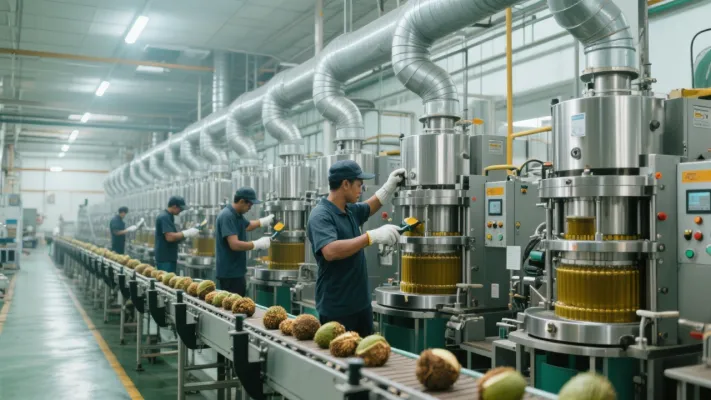
Enhancing Spiral Oil Press Export Competitiveness through Efficient Pretreatment
Optimizing the pretreatment process of oilseeds is pivotal to maximizing output and extending equipment longevity in the oil extraction industry. For manufacturers and exporters of spiral oil press machines, mastering the pretreatment of raw materials such as rapeseed, peanut, and cottonseed elevates both operational efficiency and global market competitiveness.
Key Pretreatment Stages and Their Impact on Oil Extraction
Pretreatment is a composite of essential steps: cleaning, impurity removal, crushing, steaming, and conditioning. Each phase must be precisely calibrated to the specific oilseed to reduce moisture, enhance oil release, and prevent mechanical issues such as barrel blockage.
| Pretreatment Step |
Objective |
Optimal Parameters (Example) |
| Cleaning & De-stoning |
Remove dust, stones, and foreign materials |
>99.5% purity rate |
| Crushing |
Increase surface area for oil release |
Particle size: 3-5 mm |
| Steaming/Toasting |
Inactivate enzymes, adjust moisture, improve oil yield |
Rapeseed: 95-110°C for 30-45 min
Peanut: 100-120°C for 20-30 min |
| Conditioning |
Optimize seed softness and moisture uniformity |
Moisture: 7-9% post-conditioning |
Correct adjustment of steaming time and temperature is crucial. For instance, excessive steaming of peanuts beyond 120°C risks oil oxidation, while under-steaming rapeseed causes incomplete oil release and frequently leads to press barrel clogging.
Addressing Pretreatment Challenges: Real-World Insights
Common industrial hurdles include:
- Barrel Blockages: Often caused by inconsistent crushing or irregular moisture content leading to cake compaction.
- Decreased Oil Yield: Stemmed from insufficient steam conditioning and uneven feeding.
- Equipment Wear and Tear: Resulting from abrasive impurities not removed during initial cleaning.
Case Study: A mid-sized oil pressing facility in Southeast Asia incorporated a standardized pretreatment checklist and tuned steaming parameters per oilseed type. Within six months, the operation reported a 7% increase in oil yield, a 15% reduction in equipment downtime, and a cleaner residual cake improving byproduct value.
Standardized Workflow & Quality Checklists for Consistency
To ensure replicable success, the integration of standard operating procedures (SOPs) with inspection checklists is highly recommended. Items to monitor include raw material moisture content, particle size distribution, steaming time and temperature validations, and impurity analysis.
| Check Item |
Recommended Frequency |
Acceptable Range/Standard |
| Moisture Content |
Daily before processing |
6.5% - 8.5% |
| Particle Size |
Weekly |
3-5 mm diameter |
| Steaming Temperature |
Each batch |
95-110°C (depending on seed) |
| Impurity Levels |
Daily |
Less than 0.5% |
These measurable controls help minimize variability and assure top pressing performance — details that often determine the success when competing in international oil press markets.
Pretreatment Advantages Driving Export Market Success
Implementing scientific pretreatment protocols tailored to diverse oilseeds not only improves raw material utilization but also protects the mechanical integrity of spiral oil press units. This leads to:
- Enhanced Oil Recovery: Increases ranging from 5-10% depending on seed and process adjustments.
- Reduced Mechanical Failures: Maintenance costs drop by up to 20% due to fewer clogging incidents.
- Consistent Product Quality: Standardizing prepress conditions ensures steady oil purity and cake quality, key to vendor reliability.
Readers are encouraged to assess current pretreatment workflows and consider adopting tailored SOPs to gain these tangible competitive benefits.

Questions for Reflection
To engage operational managers and technical teams further:
- Are your material pretreatment parameters optimized for each type of oilseed processed?
- Do you have documented SOPs and checklist enforcement for pretreatment stages?
- How often do unplanned maintenance or barrel blockages occur, and what are their triggers?
Unlock Your Spiral Oil Press Machine’s Full Potential
Discover how tailored pretreatment and optimized processes elevate your spiral oil press's efficiency and durability—boosting your export competitiveness on the global stage.
Explore Our Advanced Spiral Oil Press Solutions & Download Standardized SOP Templates