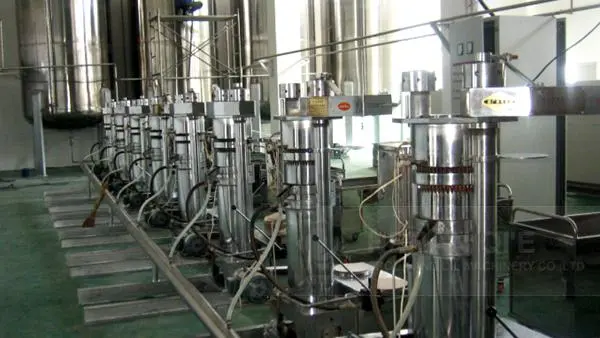
Stable, continuous oil pressing depends on more than the press itself. Oilseed preparation, consistent feeding, suitable moisture and temperature, and coordinated oil collection all influence how a production line operates.
Qi'e Group supplies oil pressing equipment and production-line solutions covering storage, screening, stone removal, crushing, conditioning, pressing and filtration. Understanding how these stages work together helps oilseed processors assess equipment suitability and define the controls needed for their project.
Mechanical oil pressing separates oil from prepared oil-bearing material through compression. In a screw-type press, a rotating screw conveys material through the pressing chamber. The screw and chamber geometry, together with resistance at the discharge, compress the material as it advances. Released oil passes through the press drainage openings, while the remaining solids leave as press cake.
Pressure formation depends on both the machine configuration and the condition of the feed. Changes in feed rate, particle preparation, moisture or temperature can affect material movement, equipment load and the separation of oil from solids.
Automation supports process control; it does not replace process preparation. Automatic feeding, temperature adjustment, sensor monitoring and fault alarms must be confirmed for the selected equipment and project configuration.
Filtration is not refining. Removing suspended solids does not establish that oil meets a particular edible-oil specification. Any required refining stages should be assessed separately against the crude oil characteristics and intended product requirements.
There is no single operating setting suitable for every oilseed. Moisture, temperature, feed rate and load should be evaluated together, using equipment specifications and trials with representative material.
| Variable | Why it matters | What to confirm |
|---|---|---|
| Feed consistency | Fluctuating supply can disturb chamber loading and continuous material movement. | Feeder arrangement, adjustment method and coordination with upstream preparation. |
| Oilseed moisture | Moisture affects material behavior during conditioning and compression. | Sampling method, preparation requirements and a suitable range established for the material. |
| Temperature | Material and pressing conditions influence oil flow and processing behavior. | Measurement locations, any heating or adjustment functions, and product-related limits. |
| Equipment load | Load changes can indicate a change in feed conditions or pressing resistance. | Available monitoring, operating limits and specified operator responses. |
| Separation and filtration | Oil collection and solids removal must accommodate the pressing output. | Collection capacity, filtration arrangement and cleaning or maintenance requirements. |
The term “fully automatic oil pressing equipment” should be assessed against an explicit function list. A press, an automatic feeder and a coordinated production line are not interchangeable scopes of supply.
Confirm the press mechanism, adjustments, monitoring points and operating limits included with the selected model. Do not assume that every control function is built into the press.
Identify the feeding, preparation, oil collection and filtration equipment included in the project, and clarify how these units connect and coordinate.
Define inspection, sampling, cleaning, maintenance and fault-response responsibilities. Automation does not eliminate the need for trained personnel or safe operating procedures.
Qi'e Grain and Oil Machinery Co., Ltd. provides oil pressing equipment alongside design, installation, technical support and after-sales services. Share your oilseed type, intended production capacity, material preparation needs and preferred automation scope to support a project-specific configuration discussion.
Explore automatic oil press equipment or review edible oil refining equipment when your project requires processing beyond pressing and filtration.

 401
|
 Qi'e Grain and Oil Machinery Co., Ltd. grain and oil machinery equipment edible oil production line hydraulic oil press edible oil refining equipment
 431
|
Qi'e Grain and Oil Machinery Co., Ltd. grain and oil processing equipment oil press selection oil production line edible oil refining equipment
 452
|
Qi'e Grain and Oil Machinery Co., Ltd. grain and oil machinery equipment oil production line oil pressing equipment edible oil refining equipment
 312
|
QIE Group automatic oil press equipment selection oilseed suitability and processing line configuration oil press equipment lifecycle costs oil press equipment acceptance
 330
|
Qi'e Grain and Oil Machinery grain and oil machinery solutions oil pressing production line edible oil refining equipment oil processing project